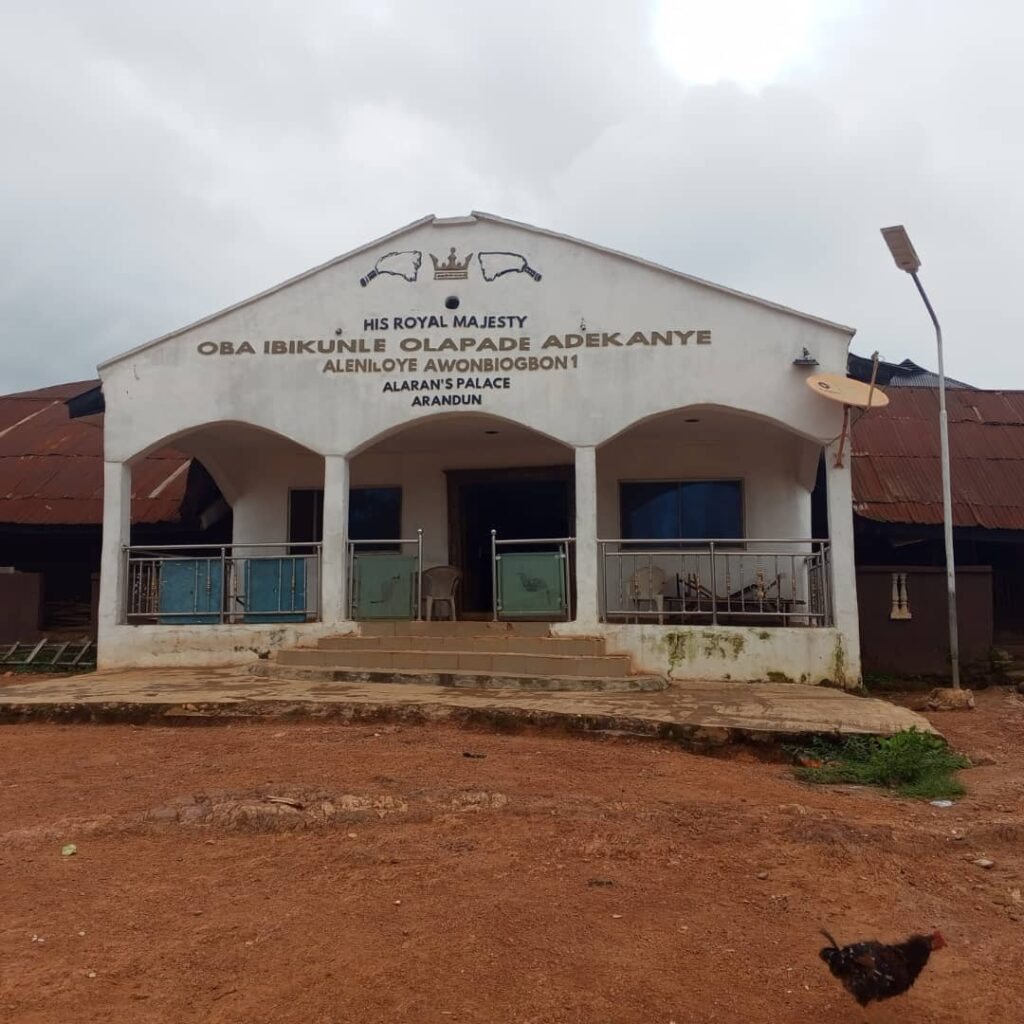
Arandun Town
- Introduction
Obviously communities worldwide usually predates written history, thus legend is almost paramount in the history of any set of people stories from ancestors to children/descent are always a vital ingredient of history. Arandun (Aran-Odun) history evolves round the sources of history like others.
- Historical Settings
Historically, after migration from his ancestral home, Ile-Ife, Oranmiyan one of the sons of Oduduwa settled at Oyo. As it was customary of the age that when princes or princesses were of age they had to search of their own domain, by way of migration from their parents.
Therefore, one of his Sons Oba Enuyomi requested for his domain and in the strict compliance with then expansionist ideology, his father the Alafin of Oyo released him and gave him such items that would portray him as a ruler of his would be domain which he (Enuyomi) had decided to name as Aran, after his home compound in Oyo town. Other princes who were his bothers and left around the same time were Olupo ofAajase-Ipo andOlusin of Isin. Their kinship relationships apply reflected in their tradition cognomen. Olupo Moje, Olusin Moje and Alaran Moje.
Among such items given to him were,
- Velveteen garment and trouser (Aso Aran and Sokoto Aran)
- A crown (Ade) which was to serve ashis instruments of office on getting to his own domain.
- A cutlass in a sheath (Ako and Ada) the cutlass being an instrument of defense.
- A set of Drums for traditional Egungun festival (Ewi).
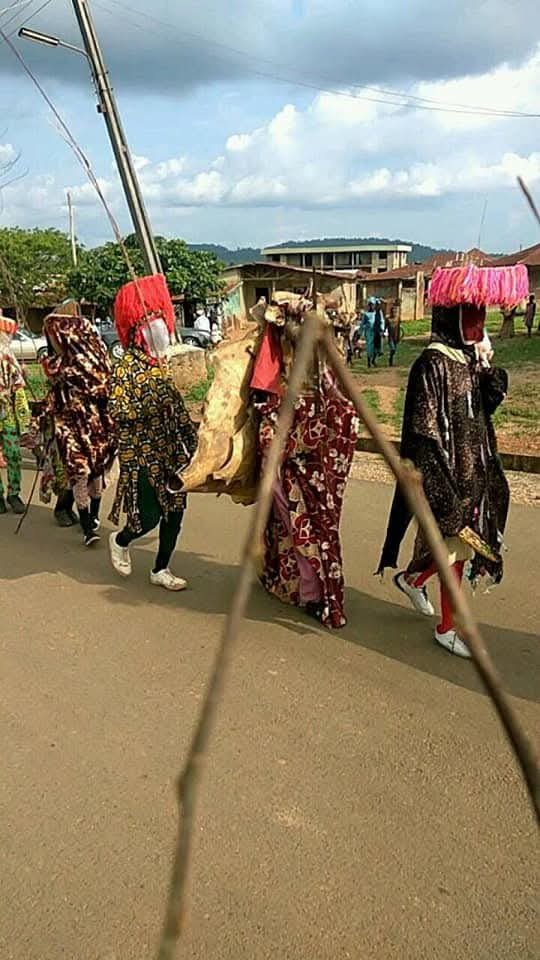
- A traditional masquerade custom (Akona) the masquerade which up till today lead the town’s Egungun population from the masquerade shrine (Igbo Egun) during Egungun festival.
- The symbol of the traditional deity God of thunder (Sango Magba).
- Settlement At Aran-Odun
The first place of settlement with his family and his followers was ARANDA (near the present day (Oke-Iya). He had to leave with his followers because the location was not suitable for their traditional occupation of farming. He left with his followers and moved down to Aran- Odun, with a River latter called Odun, that had fertile alluvial plane.
- Settlement At Omu
It was at this point in time that the reigning Oba at Omu (now Omu-Aran), Olomu-Efon who was a good friend of the sixteenth Alaran Oba Orii, he invited the later and his powerful army to help him ward off the Ibadan raids. Oba Orii assisted Olomu and battle was won. After victory was attained, the Olomu-Efon pleaded passionately with Alaran to let the two of them live together to make for victories in subsequent attacks. The two Obasi.eAlaran and Olomu entered into oral treaty that would guarantee:
- The right of each king (Oba) to rule his people.
- Equal right on land matter, farm products etc.
With the firm establishment of the Oral treaty, Oba Orii convinced his followers and made them see the need to stay with Olomu. The Alaran people back at Aran –Odun were later persuaded to come over to Omu. Oba Orii and his people were assigned a place to settle at Omu. This place was called ILE-ARAN. The two Obas co-existed side by side with each of them ruling his own people via-vis Oba Alaran at Ile Aran the place given to him and Olomu of Omu at the other side of the town. Oba Orii died at ILE ARAN in Omu and his body was taking back to Igbo Orile for burial with his ancestor.
It is pertinent to mention here that Arandun existence at its present site is dated back beyond 1840s. History has it that as the people moved to Omu with Oba Orii some did not come back to their original founder’s settlement at Aran –Odun nowArandun. This informed other descents of Aran found in other settlements other than Arandun. To buttress the initial settlement of Arandun dated back to 1840, in his book beyond d 1920, the revolutionary and power politics in Yoruba land 1840 – 1893 by S.A Akantoye PhD, 1971 Page 7 Opined that the tradition of Igbomina speaks a number of kingdoms in the distance past of which the most prominent were Orangun of Ila, Orangun of Oke-Ila, Asaoni of Ikeewu, the ALARAN OF ARAN, the Alapa of Apa, the Oloro of Oro ( now Oro Aago), the Olupo of Ajase-Ipo, the Olusin of Isin, the Elese of Igbaja and the Oloro of Eku-Mesan Oro.
- Settlement At Ajo
After the death of Oba Oluyeye the fifteenth Alaran, the people who had earlier fled following the Ibadan raids returned and regrouped with several others who had likewise fled their settlements due to the same raids. They all settled at a place called Ajo. Those at Ajo include Aran, Omu, Rore, Iloffa, Oko e.t.c. the sojourn at Ajo was short lived for the settlement was rather unwieldy and could not provide the much needed peace at the time. There was no Oba at Ajo but Odofin Aran who is the second in command to Alaran acted as the head, while Esinkin Olomu too acted as the head of Omu people. A group of disorderly people were in the settlement. It was later disbanded by captain Bawa, the then representative of colonial master.
However, before Ajo was disbanded, a few people from Aran who become disillusioned and discontented with the general attitude of Omu people broke away and founded a new settlement called Aran–Orin.
Upon the disbanded of Ajo by captain Bawa, Omu and the bulk of Aran people left behind by those relatively few who migrated to Aran–Orin decided to resettle back at their previous settlement at ILE-ARAN and Omu before they went to Ajo.
It is also of note that it was this period of their living they both agreed to bear a common name but still showed their individual identity. This informed the adopted name Omu-Aran. In spite of this name each Community continued to maintain its own identity as each continues to have a reign Oba that ruled each side.
- The Home Return On Aran Back To Aran-Odun (Arandun)
The peaceful co-existence of Aran and Omu became sour during the twentieth reign of Alaran Oba Ibuoye and Oba Olomu, Oba Momolosho as he saw the reign of Oba Alaran Ibuoye asa threat to his authority.
The trouble of the ownership of the land was placed before the District office In Ilorin. This situation led to the collapse of the age-long oral treaty between Oba Orii the sixteenth Alaran and Olomu–Efon of Omu. The District officer stepped in and advised the Alaran to leave Omu since he had no strong claim of the ownership of the land that he and his people stayed at Omu .He had to go through Aran–Orin because his home at Aran-Odun, which had been uninhabited for centuries, was already a dense forest. The time of his departure from Omu-Aran in 1929 was at the peak of heavy rainfall, therefore settlement at Aran-Odun could not be quickly effected.
Oba Ibuoye stayed for a year at Aran–Orin as a guest of his age long friend, Edemo of Igbesi. During the sojourn at Aran–Orin, most of his people settled in scattered farm settlement such as Ibale, Omirinrin, Odo Agbo, Afogbagba e.t.c. all in Aran land. Those who did not follow Oba Ibuoye continued to stay behind at Omu and formed what is now known as Aran in Omu-Aran.
The Aran people who earlier moved to various farm settlements joined their Oba at Aran-Oke. He and his people spent a year at Aran-Oke, and had to move to the present site Arandun due to boundary dispute with Orangun of Ila.
It is pertinent to note that it was the twentieth Alaran Oba Ibuoye that returned the people of Aran back to their original settlement in 1930.
History confirmed that Alaran Oba Orii left for Omu–Aran with his people while Alaran Oba Ibuoye the twentieth Oba returned them back to Aran.
The foregoing historical antecedents show that a total of twenty-four Oba Alaran has been installed upon the founding of Aran by Oba Enuyomi in the nineteenth century. In summary the reigned Obas are as follows and at various stage of settlement by Aran people.
During the first settlement at Aran–Odun
- Oba Alaran Enuyomi the founder
- Oba Alaran Abegunlegbere
- Oba Alaran Ojiji
- Oba Alaran Alokerehin Aderibigun
- Oba Alaran Soreyan Ologbeniku
- Oba Alaran Asoso Soloja
- Oba ALaran Ajigidilogun
- Oba Alaran AgboLuade
- Oba ALaran Osanyitele Agbenuola
- Oba Alaran Olanilekun
- Oba Alaran Opere Amudi Aranjoko
- Oba Alaran Olanipekun
- Oba Alaran Akolusin Akoworaiye
- Oba Alaran Ewedunmoye Adebansi
- Oba Alaran Amukuku NigboIleti
- Oba Alaranorii ( who took the Aran to omu )
- B. – At Omu
- Oba Alaran Aroyeyo
- Oba Alaran AROJOJOYE
- Oba Alaran Oluyeye
- Oba Alaran Ibuoye ( who returned the Aran back to their original settlement)
C. Subsequent Oba On Re- Settlement Back Home–Arandun
- Oba Alaran Olaoye Alebiosu
- Oba Alaran Aransiola Ilufemiloye
- Oba Alaran Amos Babatunde Orimadegun
- Oba Alaran IBIKUNLE Olapade Adekanye Aleniloye Awonbiogbon 1 (The reigning Oba)
The Four Rulling Houses
- Okesanile Odun
- Okesanile Ada
- Okesanile Okankan
- OkesanIleti
- Culture And Tradition Of Arandun
Arandun is socially a typical Yoruba society, culturally of Igbomina trait in language, dress, food, religion deities and entertainments in its entity is Manifestation. In fact, Arandun could be rightly referred to as custodians of Igbomina culture compared with her neighbor.
The people are tied together by the value being attached to the notable traditional festivals such as Egungun masquerade in which those far and near always comes home for its celebration every two calendar years.

- Biography/ Profile Of The Traditional Ruler.
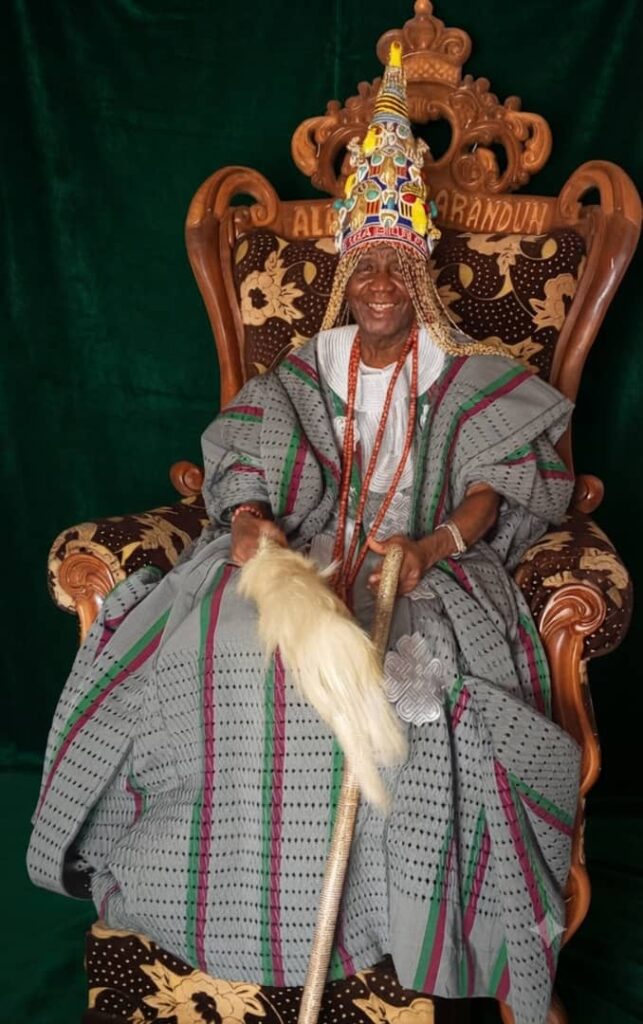
Profile Of His Royal Majesty, Obaibikunle Olapade Adekanye Aleniloye Awonbiogbon 1, The Alaran Of Arandun.
His Royal Majesty, Oba Ibikunle Olapade Adekanye Aleniloye Awonbiogbon 1, the Alaran of Arandunland, a Second Class Graded Traditional Ruler of Arandun in Irepodun Local Government Area of Kwara State, Nigeria.
- Early life Education
His Royal Majesty was born on 3rd January 1948 in Arandun, Kwara state. He began his Primary Education at Ara unitedPrimary School, Arandun/Omido, where he studied from 1955 to 1962. He proceeded to Oro Grammar school between 1963 and 1967, before attending Government Secondary School/ Ilorin School of Commerce (GSS/ISC) Ilorin, from 1968 to 1969.
In 1971, he gained admission into the prestigious Ahmadu Bello University (ABU), ZARIA, Where he pursued his university education until 1975. He successfully completed the National Youth Service Corps (NYSC) programme between 1975 and 1976. He also attained a master’s degree at Ahmadu Bello University.
After completing his NYSC, His Royal Majesty joined Kwara State Polytechnic as an academic staff member. Through dedication, hardwork, and professional excellence, he rose through the ranks as follows
- Assistant Lecturer (1976 – 1978)
- Lecturer iii (1978 – 1980)
- Lecturer ii (1980 – 1982)
- Senior Lecturer (1982 – 1984)
- Principal Lecturer (1984 – 2008)
During his distinguished academic career, he mentored countless students, contributed to the advancement of technical education, and earned the respect of colleagues and academic community.
- Ascension To The Throne
His Royal Majesty ascended the throne as the Alaran of Arandun on 24th December 2000, initially as ungraded Oba.
In 2015, His throne was elevated to the stool of a third Class graded and entering to historical origin and exemplary leadership and commitment to the development of Arandun.
In 2019, the kwaraState Government further upgraded Alaran stool to the prestigious rank of second class graded traditional ruler, affirming the growing importance of the traditional institution and His Royal Majesty’s exceptional leadership.
- Achievements And Contributions
Since ascending the throne, His Royal Majesty has remained a symbol of visionary leadership, peace, and unity. His reign has been marked by numerous achievements, including:
- Promoting peace, harmony, and peaceful coexistence among the people of Arandun and neighboring communities.
- Preserving and promoting the rich cultural heritage, customs, and traditions of Arandun for future generations.
- Encouraging educational development by supporting students and promoting the value of quality education.
- Working closely with government agencies, community leaders, and development partners to facilitate infrastructural and socio-economic development within Arandun.
- Providing wise counsel on matters affecting community growth, security, and sustainable development.
- Encouraging unity among sons and daughters of Arandun, both at home and in the diaspora, towards theprogress of the community.
- Serving as a respected custodian of the customs, history, cultural identity of the Igbomina people
His leadership style is widely admired for its wisdom, fairness, accessibility, and unwavering commitment to the welfare of his people.
- Honours And Recognition
His Royal Majesty’s dedication to community service and traditional leadership has earned him widespread recognition and respect. His elevation from ungraded Oba to a third Class Oba in 2005 and subsequently to a second class graded traditional Ruler in 2019 stands as a testament to his outstanding leadership and contributions to the growth and development of Arandun kingdom.
- Family Life
His Royal Majesty is happily married and is blessed with children and Grand children. He is a devoted Christian.