
Oba–Isin
- AN ABRIDGED HISTORY OF OBA-ISIN
What makes the history of Oba most interesting and puzzling is the fact that nobody (including the Oba people themselves) knew or still knows when Oba was founded and the exact name of the founder. Like many other communities, Oba people rely on legends oral traditions, folklore, and ethnographic and archaeological data in order to have a fair understanding of their history.
Some of the legends on the origin of Oba include the following:
- The progenitor of Oba people, supposedly called Akaigbo (Arokobioloja) sank into the ground from his place of origin and emerged at Oba from the earth at a place called Ojubo Ere (a shrine where rites are performed to the earth deity) hence the cognomen, Oba, Omo Ere (i.e. Oba, Children of the Mud) and Oba Minja, Ara Iselerin Gbingbin (i.e. Oba Minja, one that emerges from the Mud or Swamp).
- Oloba was led by a white hen and migrated from his original place to Oba. Hence the saying “Adiye funfun ni Ipile Oro L’Oba (meaning, a white hen was the foundation source of wealth at Oba).
- Oloba came from one Oba-Medu as a farmer and introduced the palm kernel into Isinland and the surrounding settlements, hence the folklore “Etitan Oloba, Oloba.
- Oloba migrated from one Ife which was an abode of the deported (the dead) into Oba.
- Oloba and his people were the leading SURVIVORS of a worldwide flood comparable to that of Noah’s time in the Bible minus the ark. While the flood was still on the earth, it was Oloba who presented a handful of soil (sand) that he had earlier tied to the hem of his clothes to Olodumare, while others were presenting items like gold, silver, and others that Olodumare rejected. Olodumare accepted a handful of soil (sand) that Oloba presented, because to Oloba what mankind needed at such a time was a dryland to step on, which Olodumare was pleased with. The Olodumare put some soil (sand) on the back of a white hen (bird) and commanded it to fly over the surface of the flood. As the particles of soil began to fall from the back of the hen onto the surface of the flood, the flood began to recede, and dry land started to appear. At last, the hen landed (Oba in Yoruba tongue), and where the hen landed the founder of Oba first Settled. Also from the word oba, “the name of OBA took its derivation. This is why reference is made to the white hen in Oba folklore as the foundation of the wealth of Oba.
- (HISTORICAL SIGNIFICANCE AND CULTURAL HERITAGE OF OBA
The antiquity of Oba variably called Oba-Igbomina, Oba Aiyegunle, and recently Oba-Isin as a town in Isin LGA created in 1996 has been proved by scholars, historians, archaeologists, and other researchers. Such researchers and scholars in their writings papers and books included Prof. Ade Obayemi, Dr. Afolayan Funsho, James Olu Opadeji, Oba Dr. Elijah Adeyemi, Prof. Jonathan Oluyori Aleru and so on. From their research and archaeological dating Oba existed around the 9th to 11th century, (about 600 years) before any other settlements in the Ile-Ire and Isin areas of Kwara State. In fact, according to Aleru, J. O., archaeological and historical findings in some areas such as Oba, Owode-Ofaro, Esie, Igbaja, Ijara-Isin and so on in Igbomina land show that the areas were inhabited by the settlers before the fall of old Oyo and the attendant Yoruba Civil wars and the influx of people into the areas.
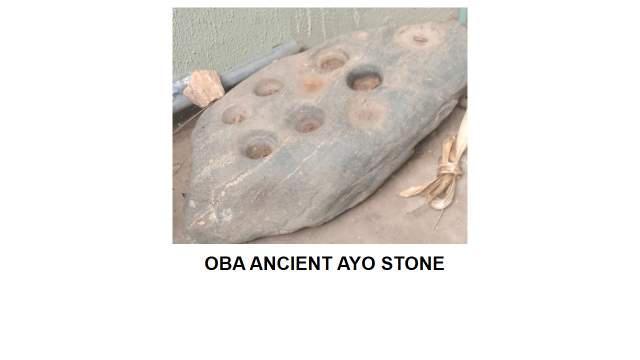
The fact that the Oba people made no claim to Ile-Ife or Oyo or any other town for descent and had no particular attachment either in their praise songs or folklores suggests absolute autonomy. James Olu Opadeji in his research paper and write-up on the history of Oba, basing his assertion on Samuel Johnson’s claim has suggested that since the Yorubas migrated from the far East in successive waves and not all the immigrants reached and settled in Ile-Ife or Oyo, it is most likely the founders of Oba were one of the groups that dropped out on the way and settled at Oba while Oduduwa and his group proceeded to Ile-Ife. Also according to Prof. Ade Obayemi, the combination of legendary art and architecture, in the Oba area compares favorably with that of Ile-Ife in central Yorubaland. These two related cultures, one in the forest, and the other in the Savanna, may have been contemporary but each had its distinctive characteristics.
As the first settler Oba had a large expanse of land more than any settlement around, and gave land to neighboring communities like Pamo, Iwo, Ijara-Isin, Owu and so on. This is why till today; Oba remains a witness to cases of land disputes among towns and communities in the area.Aleru J. O. also suggests that the Ash Mounds or Hills at Oba’gbo are relics of the dyeing industry that was populated in Oba which would appear to be the most extensive in Igbomina and this is why one of the folklores (Cognomen) of Oba has to do with dyeing as follows “Olobaabala, Abeti aso gbe bi awo, A fi Sokoto gbe de bi eniyan, Afi so koto k’osu mefa nile alaro, Alaro o gbodo re’so, Sokoto o gbodo sonu.
The earliest known settlement of Oba was at Ofaro-Oba Valley before it moved to Oba’gbo (Oba in the forest). It moved to its present site in open grassland in 1940. A 1937 record in the Kaduna Archive stated that there was an Old Oba in the Ofaro-Oba Valley, a place where the ancestors of Oba people occupied before any Nupe raids, probably before 1700 A.D. The record also had it stated that there was the Iron Crown and Iron Rod of Oba (ILOPROF3663).
Archaeological surveys and discoveries have shown iron workings and sites in Oba evidenced by the presence of Iron working apparatuses like furnaces, slag, tuyeres, anvils and so on An iron quarry, Okerin (Iron Hill) at Oba was the source of the raw iron from which Oba people made implements such as knives, arrows, cutlasses, traps, hoes, local guns in those days.
The dispersal and migration of Oba people to various settlements in Kwara State and far beyond Kwara State were due to the following.
- The Nupe incursion into Igbomina land and the Igbomina inter-tribal wars.
- Land and chieftaincy titles dispute
- The Apata Oba Massacre near Owu led to a near annihilation of the Oba people.
- Occupational pursuits like farming hunting etc
- Self-induced migrations connected with problems of child bearing and related issues.
There is no single community in Isin land and perhaps in the Igbomina area that has the same widespread population concentration among Igbomina towns and Villages as Oba does. For example we have Oreke, Oba-Ila Orangun, Oba-Oke Ila Orangun, Oba- Omu-Aran, Oba-Oro, Oba-Esie and many more. On Oba-Ila Orangun (Isedo Quarters), Afolabi Fatai (2006) records that oral tradition says that the first settler of the present Ila-Orangun was from Oba.
That the Isedo was established long before the arrival of Igbonnibi (and his emissaries) who founded the present Ila-Orangun. Oral traditions acknowledged that the collapse of Oba hegemony accounted for the presence of Oba natives in many Igbomina towns and other towns outside Igbomina area. Record of the past Orangun of Ila Orangun shows that Orangun Igbonnibi (Adegbiji) reigned between 1425- 1504 A.D. He was the one who moved the seat of the Igbomina kingdom to the present site of Ila Orangun. The first Orangun of Ila called Fagbamila Ajagun-Nla reigned between 1050-2000 A.D. From this account, Omoniyi (2018) asserts that Isedo Quarters were established by Oba settlers who must have existed long before 1400A.D.
Archaeological dating also show that Oba-Igbomina existed in the 11th Century (Aleru J. O., 2006) i.e., between 1100-1200 A.D. Afolayan Funsho, writing on “The Esie Ethic culture: Perception from Igbomina Tradition also asserts that the antiquity and early primacy of Oba is generally acknowledged.
Oba Oral King list says that twenty-one (21) Olobas were known to have reigned in Oba from time immemorial during the Era of the Oloba. However, due to a lack of written records, only SEVEN of them were remembered, yet not by name but by occupations and attributes.
- Oba Akaigbo (Arokobioloja)
- Oba Olokonigeregere Atitan
- Oba Obo baale gbayan from Oke Ajagbon compound
- Oba Okonihin Okolohun-Odolaarin-Oko
- Oba Toladebomoye from Idi-Opopo Compound
- Oba Jalokebi Irawo from Ile-Nla compound
- Oba Mumuaro from Ile Olumo (Aiyetoro Compound)
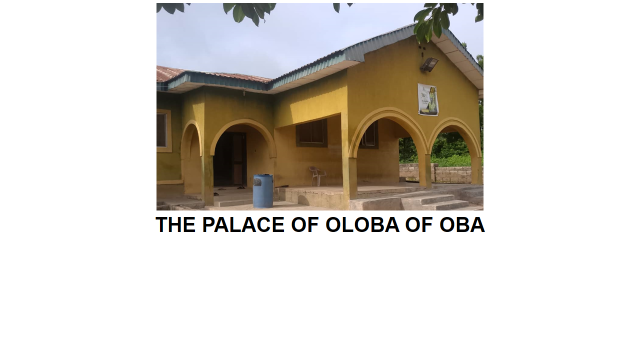
The last of the seven appeared to have reigned before 1800 A.D. after which there was a long period of interregnum (about 150 years) when no one titled Oloba reigned. The Baales and senior leaders took charge of the affairs of the community. What happened to the last Oloba was a serious sickness, a cough that made him be banished into a forest, and the curse that he pronounced on account of the act of the people caused the cessation of the era of Oloba as ruler. It was in April 1995 after the curse was broken that Oba Timothy Titilayo Oyebanji Olufemiloye I from Idi Isawo Compound was installed as the new Oloba.
- OBA PEOPLE AND THEIR CULTURE
Oba people are purely Yoruba of the Igbomina sect. The old Oba consisted of the following groups Isale Oba (Oba Ofaro), Oba-Imogba, Oba-Agangan, Oba-Okoto, Oba-Oke Oba and Aleeji.
Presently, Oba consists of ten compounds, namely:
- Idi Opopo
- Idi Isawo
- Oke Ago
- Ake Ajagbon
- Ile Nla
- Ayetoro (Ile Olumo)
- Ile Odofin (Oke Oba)
- Isale Ago (Ile Onimogba)
- Idi Iyeye
- Oke Ago Baba Ode
Oba Compounds are grouped into two wards namely Obi Oke Idajo (comprising of Idi Opopo, Idi Isawo, Oke Ago, Ile Odofin and Isale Ago) and Obi Ile Nla (comprising of Ile Nla, Oke Ajagbon, Ayetoro, Idi Iyeye and Oke Ago Baba Ode). Due respect is given to the wards and compounds in the rotational system of filling vacant stools of the Kabiyesi (Oloba of Oba), Wariwa and Baale.
Traditionally, Oba community is stratified into four age groups which are the Ewe, the Eso, the Ologun and the Oloye (oldest). Each group has functions to perform. The major occupation of Oba people is farming. Alongside with farming are trading, hunting, mat and basket weaving in the olden days, bricklaying and carpentry, dyeing and cloth weaving (in the olden days), drumming, palm wine tapping and palm produce, rope making, saw-milling and so on.The major farm products are yams, maize, guinea corn, cassava, cashew nuts, fruits and vegetables, some cocoa, palm produce, banana and plantain.
The major natural resources of Oba include iron ore, chalk deposit, sandstone, granite, quartzite, clay and others while economic trees include Mahogany, Iroko, Iya, Locust bean, Shea butter, and other trees that characterize the Guinea Savanna region. Oba has all all-season rivers such as River Awere, Omolakun and Osasa. The important hills are Oko, Oke Ore, Oke Imogba, Oke Oba and so on.The sacred deities and festivals in Oba, popular in those days were Esu Oba, Oko, Ita, Ere, Orisa Oko, Iya Alaro, Erinle, Egungun Elewe, Sekeseke Iwinta, Ogun, Sango and so on.

Education started very late at Oba, Kindergarten class, established by the Baptist Church started in 1955/56. It grew to become a full-fledged primary school in 1960/61. The Oba Community Secondary School was established in 2007.
The two major religions in Oba are Islam and Christianity. Christianity came to Oba through the Baptists who established the Baptist Church, Oba in March 1925. Islam was earlier accepted at Oba in 1921. Other church denominations such as Deeper Life, C.A.C. Redeemed Christian Church of God, and Living Faith Church (Winners Chapel) recently sprang up at Oba.
The advent of Islam and Christianity to the Oba Community has relegated traditional festivals and Idol worships to a life of extinction.
The roles and functions of age groups still exist in the Community, but the activities of clubs and societies in the Community now help in the developmental matters of the Community.
- PROFILE OF H.R.H OBA DR TIMOTHY TITILAYO OYEBANJI (J.P)
Oba (Dr.) Timothy Titilayo Oyebanji was born to the family of Pa Simon Oyebanji (Late) and Mama, Elizabeth Ajibola Oyebanji of Idi Sawo Compound, Oba in the present Isin Local Government Area, Kwara State on the 16th June, 1952. He was the first child of his parents, his father was a cocoa farmer at Omidi Onipetesi in Ile Ife area, Osun State.
Kabiyesi, Oba T.T. Oyebanji started his primary school education at Baptist Day Primary School, Oba-Isin in 1959 and graduated with First School Leaving Certificate (F.S.L.C) in 1967. Thereafter, he proceeded to Igbomina Baptist Grammar School, Isanlu- Isin in 1970 and graduated in 1974 with West African School Certificate (W.A.E. S.C.). He attended College of Education, Ilorin where he obtained his N.C.E. certificate in 1964.
Kabiyesi, Oba T.T Oyebanji started his working career as a teacher in 1974 at Community Primary School, Amodu/Asungbolu where he stayed until 1979 when he was posted to Community Primary School, Araromi/Monasara where he remained until 1984. He was moved to Community Primary School, Budo Are/Bolorunduro where he served as a Teacher/Head Teacher from 1984-1989. He served as the Headmaster of Community Primary School, Oreke Okegbo between 1989-1995. He was at Oreke when in April, 1995, he was called to occupy the school of Oloba of Oba which had been vacant for many decades. While at Oba, he was at the same time continued to serve as the Headmaster of his Alma Mater, Baptist L.G.E.A. School, Oba-Isin from 1995 to 2008 after which he retired from Government Service.
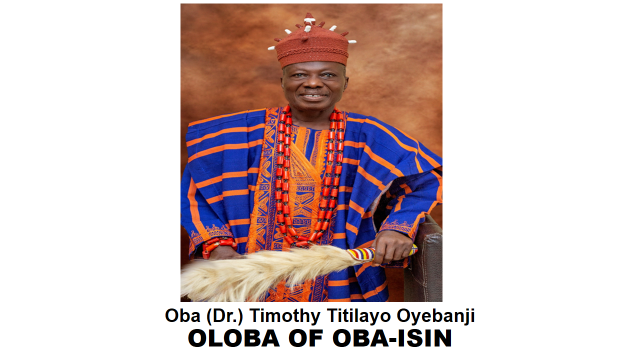
Oba Dr. T.T Oyebanji got married to Mrs. Abigail Oyebanji (nee Onifade from Oyate-Oro Ago) in December, 1979. The marriage is blessed with beautiful and godly male and female children.
Oba Dr. T.T. Oyebanji ascended the throne of Oloba of Oba-Isin on 15th April 1995 as a result of a serious desire and search to fill the stool of Oloba of Oba which has been vacant for many decades. The community gave him the title, Ilufemiloye 1 in Oba Isin. Oba Dr. T.T.Oyebanji was the first Oloba to be recognized by the Igbomina/Ekiti Traditional Council and he was the first Oloba to receive a staff of office as a 4th class Oba in Kwara State on 11th October, 2006. He served as Secretary of Isin Traditional Council for some years.
Email: obadevelopmentassociation@gmail.com
Facebook: https://www.facebook.com/groups/obadevelopmentassociation/