
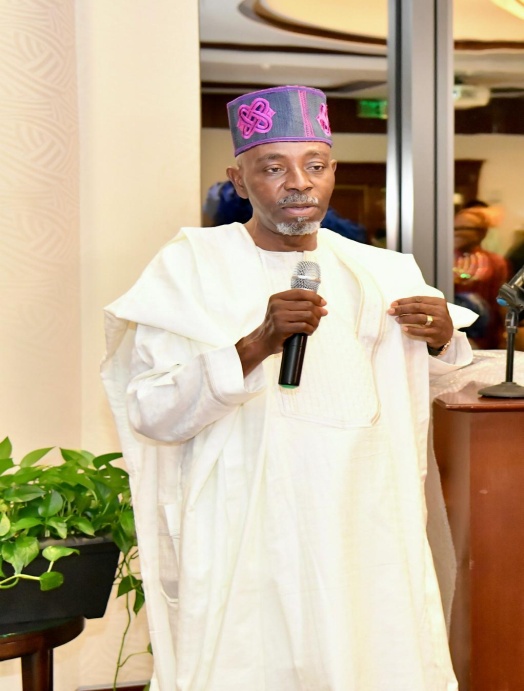
Chief Lateef Adebisi Amolegbe
- BACKGROUND
Chief Lateef Adebisi Amolegbe was born on August 11, 1953, in Okeya-Ipo, Irepodun Local Government Area of Kwara State, Nigeria. He was born into the distinguished family of Late Alhaji (Chief) Yusuf Amolegbe and Late Alhaja Raliat Amolegbe.
He began his early education at Okeya Primary School before proceeding to Esie-Iludun Grammar School for his secondary education. Determined to pursue higher learning, he attended Yaba College of Technology, Lagos, for his advanced studies. At the age of twenty-one, he relocated to the United States of America in pursuit of greater educational opportunities. He earned a Bachelor’s degree from Hawthorne College, New Hampshire, and subsequently obtained a Master’s degree from Howard University in Washington, D.C.
On January 20, 1979, he married his beloved wife, Mrs. Sherifat (Agnes) Aderonke Amolegbe. Their successful union has been blessed with three daughters, Bilikis Shade Amolegbe, Khalilat Abiola Amolegbe, and Faidat Yetunde Amolegbe, as well as two cherished grandchildren, Khaliq Jabar Bramlett and Khamilah Jael Bramlett.
Chief Amolegbe was raised in a family known for enterprise, philanthropy, and community leadership. His father, Alhaji Yusuf Amolegbe, fondly known as Oredola Okeya, was a prosperous trader, respected community leader, and renowned philanthropist across Igbomina land. His mother was an accomplished businesswoman admired for her charisma, courage, intelligence, and social influence. These values of leadership, service, and integrity greatly shaped the character and outlook of Chief Lateef Amolegbe.
- COMMUNITY DEVELOPMENT AND LEADERSHIP
Chief Lateef Amolegbe has distinguished himself as an exceptional leader whose influence and contributions have left a lasting impact on Yoruba and Kwara communities in North America. Widely admired for his charisma, courage, intelligence, and integrity, he has dedicated much of his life to community development and organizational leadership.
His fingerprints are evident in the establishment and growth of several major Yoruba and Kwara organizations in the Washington, D.C. metropolitan area. He was a pioneer member and later President of the Kwara State Association, Washington, D.C., founded in September 1993. He also played a significant role in the establishment of Isokan Egbe Omo Yoruba and co-founded the Alliance of Yoruba Organizations and Clubs in 1996, an organization he successfully led for several years.
Additionally, Chief Amolegbe is a founding member and leader of Egbe Omo Igbomina USA, now known as Igbomina Community North America. Through these organizations, he has consistently promoted unity, cultural preservation, and community empowerment among Nigerians in the diaspora.
Following in the footsteps of his late father, Chief Amolegbe became actively involved in transforming the Kwara State Association, Washington, D.C., into the Kwara State Association of Nigeria North America (KSANG), a body representing Kwarans across North America.
In August 2008, he was elected Vice President of KSANG. Following the resignation of the National President in January 2009, he assumed the position of National President. During his three-and-a-half year tenure, he introduced innovative fundraising initiatives that significantly strengthened the organization and positioned it for long-term sustainability.
One of his most notable achievements was fostering collaboration between KSANG and the Kwara State Government. Under his leadership, both parties signed a Memorandum of Understanding focused on improving healthcare delivery in Kwara State. He also presided over the first-ever KSANG Medical Mission, a landmark project jointly funded by KSANG and the Kwara State Government. Chief Amolegbe also serves as a Trustee of the Alliance of Yoruba Organizations and Clubs and as a Board Member of KSANG Homes International Inc., continuing his lifelong commitment to community service and organizational development.
- LEADERSHIP PHILOSOPHY
Chief Amolegbe lives by a simple yet powerful philosophy: “Work. Play. Do Good.” This guiding principle reflects his commitment to excellence, lifelong learning, community service, and the empowerment of others.
Known for protecting his integrity and reputation, he approaches leadership with foresight, wisdom, and empathy. His ability to understand different perspectives, combined with exceptional communication skills, has enabled him to build trust, inspire confidence, and unite people around a common vision.
His charismatic personality and unwavering commitment to service have earned him the admiration and respect of colleagues, associates, and community members alike. He believes that true leadership is not about creating followers but about creating leaders and empowering others to excel.
Behind his success stands his devoted wife, Mrs. Sherifat (Ronke) Amolegbe, whose unwavering support, intelligence, and commitment have been invaluable throughout his journey. Together, they have raised daughters who embody strong cultural values, respect, and excellence, reflecting the family’s enduring commitment to heritage and community.
- AWARDS AND HONORS
Over the course of his distinguished life, Chief Lateef Adebisi Amolegbe has received numerous awards, recognitions, and traditional honors from organizations in both the United States and Nigeria in acknowledgment of his exemplary leadership, community service, and philanthropic contributions.
A highly respected community leader and holder of several chieftaincy titles, he was most recently conferred with the prestigious title of Gbobaniyi of Koko Araromi, Kwara State, Nigeria, on July 19, 2025, in recognition of his outstanding service, leadership, and dedication to community advancement.
- LEGACY
Chief Lateef Adebisi Amolegbe’s life is a testament to visionary leadership, selfless service, and community empowerment. Through his contributions to educational advancement, cultural preservation, healthcare development, and organizational leadership, he has left an enduring legacy that continues to inspire present and future generations of Kwarans, Yorubas, and Nigerians across the world. His story reflects the power of integrity, commitment, and purposeful leadership in transforming communities and impacting lives.