
Oko-Irese
Oko-Irese is an ancient Yoruba town located approximately 7 kilometres North of Omu-Aran and about 5 kilometres South of Olla in Irepodun Local Government Area of Kwara State. The town was founded about 1570 AD, over 455 years ago.
According to oral tradition, Oko-Irese traces its origin to Oranmiyan, one of the legendary founders of the Yoruba Kingdom and a son of Oduduwa. Tradition holds that during Oranmiyan’s reign, the birth of twins or triplets was considered a taboo and such children were customarily sacrificed to the gods.
Incidentally, one of Oranmiyan’s wives later gave birth to a set of male triplets. While he respected the customs of the time, he could not bear to lose his children. Through a secret arrangement with the Ooni of Ife, the mother and her children were relocated to a secluded cave at Ore Hill, where they lived under his protection. Oranmiyan frequently visited them and named the three children Irese, EleseAjiboro, and Awo.
When he was later accused of violating the tradition, Oranmiyan reportedly responded, “I accept my wrongdoing, but I rejoice.” This declaration gave rise to the famous praise expression associated with his descendants: “Okoọmọajẹbi, ọ̀rọ̀ yọ.”
- AS THE CHILDREN MATURED:
Irese founded Oko-Irese in present-day Irepodun Local Government Area of Kwara State.
EleseAjiboro migrated to establish Igbaja in present-day Ifelodun Local Government Area of Kwara State.
Awo founded Oko in present-day Surulere Local Government Area of Oyo State.
Irese later married a woman from Oko-Ile and lived with his family in the Ore Hill cave until his death. Following an incident that sealed the cave, the inhabitants relocated to the plains of Isara, where settlers from different parts of Yorubaland joined them. This led to the formation of the present-day Oko-Irese community.
Today, Oko-Irese comprises seven traditional wards:
- Irapa ward headed by the Petu of Irapa as their Baale
- Iwoye ward headed by the Ooye of Iwoye as their Baale
- Odo-Oko ward headed by the Ooye of Odo-Oko as their Baale
- Idemorun ward headed by the Edemorun of Idemorun as their Baale
- Inishan ward headed by the Enishan of Inishan as their Baale
- Owaro ward headed by the Olowa of Owaro as their Baale
- Odo-Aba ward headed by the Enigbin of Odo-Aba as their Baale
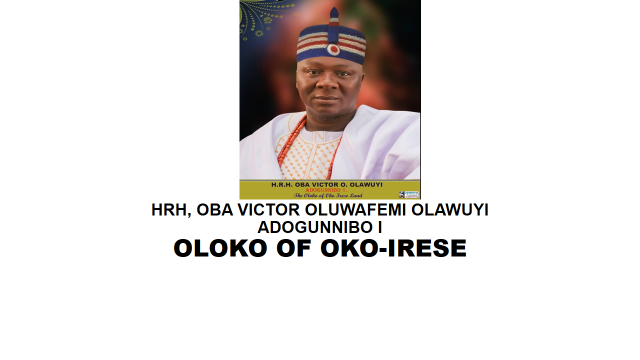
Since the formation of the town, Oko-Irese has been governed by a succession of distinguished traditional rulers and administrators, culminating in the reign of HRM Oba Victor OluwafemiOlawuyi, Adogunnibo I, who ascended the throne in 2005.
Today, the Oloko of Oko-Irese is a graded traditional ruler recognized by the Government of Kwara State. The long and uninterrupted line of monarchs reflects the rich history, stability and cultural heritage of Oko-Irese as one of the oldest settlements in Igbomina land.
- HISTORICAL SIGNIFICANCE AND CULTURAL HERITAGE
One of the most significant cultural and historical symbols of Oko-Irese is AkitiOko, a revered mystical figure deeply rooted in the town’s oral tradition.
Historical accounts associate AkitiOko with Oranmiyan, who according to local belief, returned spiritually after his earthly death to protect and strengthen his descendants during periods of war and adversity. Through extraordinary mystical powers, AkitiOko became a symbol of courage, divine protection, resilience and the enduring spiritual heritage of Oko-Irese.
The community continues to preserve this rich cultural legacy through traditional festivals, oral history, royal institutions and customs that celebrate its unique ancestry and identity.
- BIOGRAPHY OF HRM OBA VICTOR OLUWAFEMI OLAWUYI, ADOGUNNIBO I
His Royal Majesty, Oba Victor OluwafemiOlawuyi, Adogunnibo I, was born in the early 1970s to the family of Pa BabatundeOlawuyi and Madam Mary OjuolapeOlawuyi of the Adogunnibo Ruling House, Iwoye Ward, Oko-Irese.
He began his primary education at Community Primary School, Oko, in 1978 before transferring to St. Michael Primary School, Ilorin, in 1979, where he obtained his First School Leaving Certificate in 1985. He proceeded to Christian Commercial College (CCC), Oro-Ago, between 1986 and 1992 for his secondary education.
Driven by a passion for learning, he later gained admission into the University of Ado-Ekiti (UNAD), now Ekiti State University (EKSU), where he studied Banking and Finance.
His commitment to community development became evident early in life. Between 1994 and 1999, he served as the National Secretary of the Oko Youth Movement, where he championed programmes aimed at promoting unity, youth empowerment, and community development.
On 1 October 2005, he was installed as the Oloko of Oko-Irese Land. Since ascending the throne, he has provided visionary and inclusive leadership marked by wisdom, humility, transparency, and dedication to the welfare of his people.
Over the course of his reign, Oko-Irese has witnessed remarkable progress in infrastructure, community development, youth mobilisation, peace-building, and social cohesion. His administration has consistently encouraged education, self-development, and active participation of both indigenes at home and in the diaspora in the development of the community.
His guiding philosophy is “While there is life, there is hope and when the going becomes tough, it requires a resilient mind to keep going.”His Royal Majesty is happily married to Olori Grace AbosedeOlawuyi, and their union is blessed with princes and princesses.